First: Tellicherry is a grade, not a variety
The most common misconception about Tellicherry pepper is that it comes from a special plant. It doesn't. Tellicherry pepper is Piper nigrum — the same species as all black pepper — grown along Kerala's Malabar coast.
The name comes from Thalassery (anglicised as Tellicherry), the port town in northern Kerala from which the finest Malabar pepper was exported for centuries. Over time, "Tellicherry" came to signify the best of the harvest: the largest, ripest berries, sorted out and sold at a premium. Today it functions as a grade designation — a promise about size and quality, not botany.
So when you compare "Tellicherry pepper" to "regular black pepper," you're comparing the top of the harvest to the rest of it.
The Indian pepper grading ladder
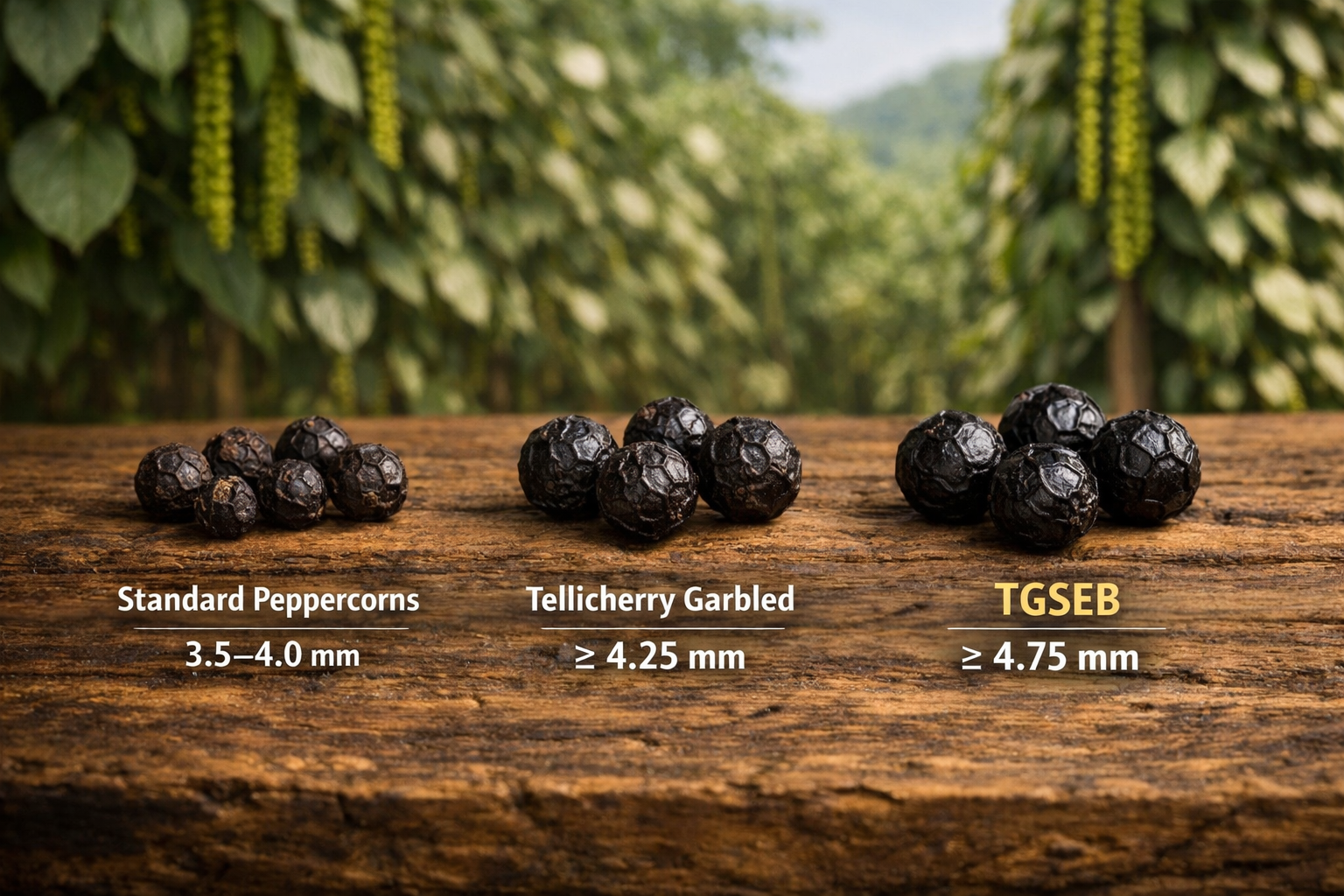
Indian black pepper is graded primarily by berry size (measured in millimetres) and density. Simplified, the ladder for Malabar-coast pepper looks like this:
| Grade | Meaning | Minimum berry size |
|---|---|---|
| MG1 / Regular | Malabar Garbled, standard trade pepper | ~3–4 mm |
| TG | Tellicherry Garbled | 4.0 mm+ |
| TGEB | Tellicherry Garbled Extra Bold | 4.25 mm+ |
| TGSEB | Tellicherry Garbled Special Extra Bold | 4.75 mm+ |
TGSEB sits at the top. Each step up the ladder is more selective, and the quantity that qualifies shrinks sharply — in a typical harvest, only a small fraction of berries grow to 4.75 mm or beyond. That scarcity is the honest reason TGSEB costs more.
What "garbled" means
"Garbled" sounds odd in modern English, but in the spice trade it has meant the same thing for centuries: cleaned and sorted.
Ungarbled pepper straight from drying contains light and hollow berries, pinheads (immature berries), bits of stalk, and dust. Garbling removes all of it — by winnowing, sieving, gravity separation, and finally sorting. What passes garbling is dense, uniform, and free of debris.
Light, hollow berries have less oil and less flavour, but weigh into every kilo you buy. Garbled pepper means you're paying for pepper, not filler.
Why size genuinely matters
Berry size in pepper is a proxy for ripeness. Berries that grow to 4.75 mm+ stayed on the vine longer, and that extra time does two things:
More volatile oils. Pepper's aroma — the citrusy, piney, floral top notes — comes from volatile oils in the berry. Riper berries carry more of them. This is why TGSEB smells noticeably brighter and more complex the moment you crack it, compared to the flat, one-note sharpness of ordinary ground pepper.
A fuller, rounder heat. Piperine provides pepper's pungency. In a well-ripened bold berry, that heat arrives layered with aroma rather than as a harsh spike. The result is pepper you can taste, not just feel.
The practical upshot: with TGSEB, a lighter hand delivers more flavour. Many buyers find they use less pepper, better.
How to check what you've bought
You don't need lab equipment to verify a TGSEB claim. Three quick checks:
- MeasureLine up berries against a ruler. Genuine TGSEB berries run 4.75 mm and up — visibly larger than the ~3 mm berries in a standard supermarket jar.
- Feel the weightGarbled bold pepper is dense. A handful should feel heavy for its size. Hollow, light berries suggest ungarbled or inferior stock.
- Crack oneCrush a berry between two spoons and smell it. TGSEB releases a bright, citrusy, almost floral aroma immediately. Stale or low-grade pepper smells dusty and flat.
The honest summary
TGSEB is not magic, and it's not a different plant. It is the most selective size-and-quality grade of Indian black pepper: the ripest, largest, cleanest berries from the Malabar harvest. If you grind pepper fresh and cook food where pepper matters, the difference is easy to taste. If you only ever stir pre-ground pepper into a simmering pot, save your money — and read our honest comparison first.
Our TGSEB pepper
Nature Presents sources Tellicherry Garbled Special Extra Bold peppercorns from Kerala's Malabar coast, packed whole to preserve the volatile oils until the moment you grind.